Tuesday, May 29, 2007

Spirit Filled Bob

I finally finished watching No Direction Home, Martin Scorsese’s Documentary on Bob Dylan. I had seen the first half of it on PBS last year in MN but didn’t see the second part until I borrowed it from my brother. I thought it was pretty good. I think it gave Jill a new appreciation for Dylan.

My favorite quote from the documentary came from some crazy looking hippie who worked with Dylan on one of his albums. When speaking of Dylan’s success, he said, “I believe giving credit where credit is due. I don’t think Dylan had a lot to do with it. I think God, instead of touching him on the shoulder; He kicked him in the (butt). Really, and that’s where all that came from. He can’t help what he’s doing. I mean, he’s got the Holy Spirit about him. You can look at him and tell that.”

Sunday, May 13, 2007

What Lies Ahead, I Have No Way of Knowin'


I’m going to be out of town this next week, so if I don’t post any, that’s the reason.

Keep Jill and me in your prayers if you remember. We’re still seeking God’s direction for the next step in our lives.

I’ve always been a bit of a worrier. I tend to live in the future and plan everything out well in advanced, so not knowing where we’re going has been a little stressful for me. But, I’ve felt a lot better about not knowing these past few weeks. I’ve come to the conclusion that waiting for God’s leading is much better than rushing into some forced decision. Everything doesn’t have to happen according to my timetable. God certainly has the power to lead us where and when He desires. If He really wants us to be somewhere, I’m sure he can get us there. The most important thing I can do is simply be faithful today and let God worry about the future.

I came across these words of Henri Nouwen that encouraged my soul. “Be sure that you love the life you’re living now, your studies, your prayers, your friendships…Then you can trust that God will reveal to you the direction to go when the time comes. But don’t try to know now what you only have to know a few years from now.”

Wednesday, May 9, 2007

The Honeycomb Evangelization


The conquest of my holistic remedy indoctrination of the world has begun. Jill was getting groceries yesterday, and the cashier sneezed and said, “Oh, my allergies are killin’ me!” Jill responded, “You may want to try taking some honeycomb. I know it sounds weird, but my husband took it this spring and his allergies have been cured…”

Tuesday, May 8, 2007

A Long Lost Friend


Five or six years ago I read Henri Nouwen’s Sabbatical Journey. It is his personal diary from the last year of his life. I picked it up last night and read through some of the passages I had marked. It encouraged my soul. I felt as if I was reconnecting with a dearly loved friend who had moved far away and whom I had forgotten about. Nouwen’s unguarded and honest reflections have a way of reminding me that I am not alone in my journey. His words express what I know to be true but have not been able to articulate. Here are a few tidbits:

“Why should I ever think or say something that is not love? Why should I ever hold a grudge, feel hatred or jealously, act suspiciously? Why not always give and forgive, encourage and empower, give thanks and offer praise? Why not?”

“It’s time to make a radical choice for solitude, prayer, and quiet writing.”

“I pray that I can be focused on Jesus and not too concerned about what everyone thinks or says.”

“The more faithful I am to my solitude, the more fruitful it will be in my community.”

Sunday, May 6, 2007

Existential Suffering


I just finished reading an extremely moving book called Lament for a Son by Nicholas Wolterstorff. It is Wolterstorff’s journal of sorrow following the tragic death of his twenty-five year old son who died in a climbing accident. The book reminded me a lot of Lewis’ A Grief Observed. Wolterstorff’s and Lewis’ journeys through grief are considerably different, but both books give us a deeply personal account of suffering. Both give us hope that God can be trusted, even in the midst of tragic and unexplainable pain.
These books remind me that philosophical arguments are often rendered powerless in the face of existential suffering. Reason provides little comfort to those whose loved ones have tragically died. It is difficult to see the point of philosophical arguments through eyes soaked with tears. In times of great personal suffering, it is the resources of divine revelation that give us hope. The suffering of Christ reminds us that we do not suffer alone. The Resurrection reminds us that death has been conquered. The presence of the Holy Spirit fills us and allows us to go on living despite our pain.

Monday, April 30, 2007

Mr. Blasphemy


I’m trying to avoid writing overly-long, self-indulgent posts on this blog, so when this post starting getting way too long, I divided it into two separate posts, both dealing with the problem of evil in the form of natural disasters.

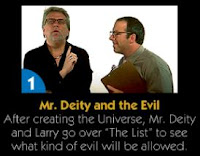
A friend of mine told me about some short, sitcom-like sketches on youtube called “Mr. Deity.” The sketches portray God as the bumbling CEO of the universe. There are currently 8 or 9 episodes, and the first one pokes fun at why God allowed so much evil in the universe. (I’m not recommending that you watch these clips, especially if you are easily offended. They are very antagonistic toward Christianity and aim at insulting almost everything I believe as a Christian)

In the first episode, Mr. Deity is having a conversation with his consultant Larry about what evils he should allow into his creation. About half-way through the episode, Larry brings up the topic of natural disasters:

Larry – “Umm, well, the next one, I checked with the boys down on research on this, and they said we’re safe to leave it out.”
Mr. Deity – “What is it?”
Larry – “It’s that natural disasters compliment; the earthquakes, floods, tsunamis….”
Mr. Deity – “Yeah, I need to have that in.”
Larry – “But sir, I spoke with the head of R&D. He said if we leave this out, it’s not going to affect anybody’s freewill or violate any natural law or anything, and since you’re already way over quota on the gratuitous pain and suffering…”
Mr. Deity – (interrupting Larry) “Here’s the thing, if we take it out, it’s going to be way too easy for people to believe in me.”
Larry – “No, sir, let me go over the list: holocausts, torture, and Downs syndrome. Those three alone, make it kind of hard to believe in you.”

The creators of Mr. Deity see the challenge that natural disasters pose for Christianity. Why do earthquakes happen? Why did God allow hundreds of thousands of people to be tragically killed in the tsunami that struck Southeast Asia? These are really tough questions.

The Devil Did It


I recently finished a book entitled The Doors of the Sea: Where was God in the Tsunami? by David Hart. It is a tiny book with a glossy cover, but don’t be fooled into thinking it’s a simplistic pop-Christian read like The Prayer of Jabez. Hart is a serious theologian whose style of writing is almost as challenging as the problem of evil itself. He presents his defense of God’s goodness by cloaking it in poetic and archaic language. On almost every page the reader encounters words like “interlocutors,” “stochastic,” and “lachrymose”. It’s a great little book, but be sure to have a dictionary nearby!

Hart is from the Eastern Orthodox tradition, so his approach of theodicy tends a bit more toward Irenaeus than Augustine. He is very critical of Calvinists who consider natural evil like the tsunamis as being a part of God’s sovereign plan. Hart argues that God is wholly good, and therefore never causes any inherently evil event. Horrendous evils should never be attributed to the hand of God.

So, if God does not cause tsunamis, where do they come from? Hart believes that we should take the New Testament worldview more seriously. The NT authors were not sterile, modern theists who philosophized about the problem of evil. They were passionate followers of the Messiah who believed that a cosmic battle was being waged between good and evil. They were confident that God would be victorious in the end, but they also believed that evil spirits were at work in the world. So, what causes horrible natural evils? Hart suggests that it may be demons and devils.

Let me reiterate, Hart is not some crazy televangelist on cable TV. He is a scholarly theologian. He believes that the best way to explain all evils, natural and moral, is to attribute it to free beings. Humans cause much of the moral evil that we experience. Perhaps free, spiritual beings cause much of the other evils.

Hart doesn’t fully develop his view. He suggests this as an explanation of evil, and then moves on. I find his suggestion interesting, but I also wonder if it really settles the issue. I would have to ask, why does a good God allow these evil spirits to wreak havoc on humans who do not know that these spirits are acting? Couldn’t an all-powerful and good God stop events like tsunamis? Hart’s book is interesting, but not fully convincing.

Friday, April 27, 2007

One Crazy Dream


There’s a great song on one of Bob Dylan’s earlier albums entitled Talkin’ World War III Blues. The opening lines of the song are, “One time ago a crazy dream came to me. I dreamt I was walkin’ to World War III. Went to the doctor the very next day to see what kind of words he could say. He said it was a bad dream.” It’s probably the most amusing and whimsical song I have ever heard about a World War.

I say all of that to say this; I had one of the strangest dream a few nights ago. I dreamt that I was at some kind of professional conference, and I was standing is a large reception area with a lot of other people. There was nothing too exciting going on at the conference when suddenly, people started rushing to look out large, main window. As I looked, I saw a nuclear explosion in the distance, and there was no time to prepare for what was going to happen. It’s hard to explain what I experienced next, because everything happened in the course of about two seconds. I saw blinding light and fire rushing towards us at an infinite speed. I felt myself flying through the air in the midst of the light and the fire. Then, everything was black, and I knew I was dead. But, I didn’t wake up.

My death happened so quickly that I didn’t even have time to feel fear or sadness. In the midst of the blackness, I remember thinking to myself, “I am dead. I was just killed in a nuclear explosion….but….I am still thinking….” A few seconds later, I woke up.

I’m not really sure what this dream means. I think it’s pretty humorous that my first thought after death was that I was still thinking. I take this as a clear sign that I’ve been reading too much philosophy lately.

Sunday, April 22, 2007

My Pastor, The Rock Star


We’ve been attending a really big church since we moved here last summer, and it’s been a good experience for us. We’ve been able to see some of the pros and cons of the mega-church culture firsthand. The most negative aspect for us has been our inability to connect to a smaller and more personal community within the church. It’s difficult to get to know people in a church of over 8,000 in attendance. I don’t want to blame this all on the stereotypical “mega-church” problem. They really do try hard to get people connected. Part of our inability to connect is due to the limited amount of time we will be staying in Lexington and our realization that most relationships we have here will be temporary. We could have done a lot more to get to know people in the church, but we’ve failed to make much effort. Plus, we have some good friends at the seminary, so we have even less motivation to get connected at church.

For me, the best part of our church has been the ministry of our senior pastor. It’s been an excellent experience watching his ministry over the past year. I have learned so much from him, and I have grown to deeply respect him as a minister and as a person. He’s only about five years older than I am, but I see in him that kind of man that I want to become. He exudes passion and excellence in his ministry, and he does so with a spirit of humility and grace. He is a great leader, but he seems to be more defined by his love for Jesus than his need for power. He has been a great example for me and has revitalized my desire to be in ministry.

The weird thing about this is that I don’t know him, so he feels more like a rock star to me than a pastor. Despite not knowing him, I really do care about the guy. He’s told several stories in his sermons about people attend the church that run into him in the city, and they will do things like come up to him and hug him in the middle of a grocery store, even though he doesn’t know them…..and the strange thing is, I know why they do it! I’ve never loved someone so much whom I’ve never met. I think for the first time I understand how people can become infatuated with famous people. There is something about the celebrity that inspires the fan, and the fan ends up feeling close to the celebrity, without knowing the celebrity.

The public nature of ministry, leads people to think they know the minister better than they really do. This puts a lot of responsibility on the part of the minister, but it also gives him the chance to influence their lives in more ways than he could ever realize. Even when I served at a church with only 225 attendees, I remember feeling strange at times because some people whom I had only met once or twice treated me like I was their long-lost son or their best friend. It always felt odd to me. I didn’t know why they treated me that way, nor did I realize the kind of influence they were allowing me to have in their life. After attending our current church for a year and loving my pastor the way I do, I think I now understand.