Showing posts with label Theology. Show all posts

Saturday, March 13, 2010

The Real God

Do I see God for who he truly is, or do I see God for how I would like him to be? Is God real; is he truly other, or do I worship a God who is shaped in my image, crafted in my head by all that I wish Him to be? Even when I pray and study Scripture, am I encountering the Living God, or am I simply attempting self-improvement through these rituals of discipline?

I have been thinking about God’s reality these past few days, which oddly enough, is something I don’t often think about. I’ve always believed in God. I’ve always known that He is real, at least theoretically. God is real, even more real than I am, but, while I know He is real, I do not always live with an awareness of His reality. Not that I deny His existence or doubt His truth, but I do tend to treat Him as if He is there in order to serve me or to fulfill my desires. Perhaps I have focus too much on God’s imminence and not enough on His otherness. I meditate on His love and compassion but much less on his Lordship and sovereignty.

God longs for and expects my devotion, yet I often get this turned around. Rather than submitting to the will of this very real King of Creation, I seek to bend His will to mine. I ask Him to serve me, to bless me, to transform me. He becomes the means to my ends. I treat Him as if He exists to fulfill my life. How egocentric! How corrupt is my thinking!

Today I recognize that God does not exist for my pleasure; I exist for His. I am created by Him and for Him. While He does desire union with me, He does not need me. I, on the other hand, would cease to exist if it were not for his constant, sustaining reality. All that I am rests completely on His Being. I am only because He Is.

Today I am thankful that God is a real and loving Father. He understands this perversion in my thinking, but He still calls me His son. I may often be the son who thinks His Father’s only purpose is to make his son happy, to give him his inheritance whenever he wishes to receive it. I may forget that I would not even be here if it weren’t for the will of my Father. Yet He still loves, as a patient Father loves his children. He is longsuffering with my self-centeredness. He blesses me even though I don’t deserve it. He gives grace, even to those who selfishly seek it.

Tuesday, April 28, 2009

Rational Faith

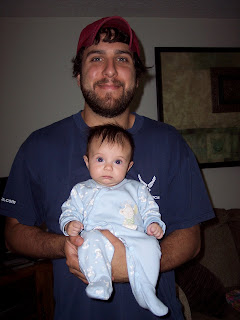
You’ll have to excuse my failure to post over the past month. It’s been busy with Holy Week, Easter, and family visiting. I’m also realizing how much less time I’ve had this year compared to last year, before Jovi was born. That darn kid sucks up much of our free time.

Anyway, I still have found time to read (perhaps this is because I’m a pastor and really only work one day a week….haha), and one of the best books I’ve read in a long time is Timothy Keller’s “The Reason for God.” If you are a person who questions whether or not Christianity is true or if you deal with people who are skeptical of Christianity, I highly recommend this book.

Keller is a pastor in New York City, and his book was written from the perspective of the many conversations he has had with skeptical New Yorkers about faith. While Keller’s primary role is as pastor, he is extremely well versed in philosophy. What is great about his book is not the originality of his ideas and arguments. I’ve come across all of his arguments in other books of philosophy or theology. But, what is great is how logical and accessible his book is. He covers the most common arguments that skeptics use to attack the Christian faith, and responds to those arguments with great precision and clarity. He brings together some of the best arguments Christian thinkers have to offer (the book is well documented, repeatedly quoting C.S. Lewis, Alvin Plantinga, Soren Kierkegaard, and a wide variety of authors from across the spectrum), and he does it in a way that I think most serious-minded laypeople could understand. This is an excellent introduction to apologetics and would be the first book off my shelf that I would give to skeptic of the Christian faith.

Wednesday, February 25, 2009

The Shack

A friend recently asked me if I had read "The Shack" and what I thought about it. So, I figured I'd post my response to him:

Dear friend,

Back in October a lady from our church came up to me and said, "Pastor Tristan, you have to read "The Shack." I want to know what you think about it. I loved it so much that I went out and bought a second copy, so take this one and let me know what you think.”

My first thought was, oh great, now I have to read some poorly written Christian fiction book (not exactly my favorite genre). But I did want to read because I really appreciate the lady who gave it to me. She's only been a Christian for a few years, so I figured I'd bite the bullet and suffer through some cheesy Christian novel in order to connect with her.

A few pages into "The Shack," I was pleasantly surprised to find that the book was fairly well written. Also, I was relieved to find that its plot didn’t center on a dispensationalist view of the end times…I’m amazed at how many of those the Christian press can publish in a given year! When I finished reading it I had a lot of thoughts on the book, but I’ll try to limit them here to a few positive ones and a few negative ones:

Here's what I liked: 1. Young at least attempted portray God as Triune. All attempts to write about the Trinity in fiction will fail because the Trinity is intrinsically mysterious and beyond our understanding, but I found it refreshing that Young emphasized God's 3-ness. Most popular writers tend to write generically about God, and their writings unintentionally assume God’s oneness. The Trinity is central to all we believe about God, so I commend Young’s attempt to bring the Trinity into popular Christian conversation, even though his attempt falls short at times.

2. The book is about suffering and the problem of evil, and I think it does an ok job of addressing the question of how a Good and All-powerful God would allow people to suffer. I believe this is the hardest questions that Christians have to answer, and Young does an adequate job of speaking to this question in the form of popular fiction.

3. Young also stresses freewill. I’ve read a few scathing critiques of “The Shack” by popular evangelicals, but almost all of them were from a Calvinist background. I could see why a Calvinist wouldn’t like this book because the characters are free and God’s sovereignty doesn’t infringe upon their freedom.

Here's what I didn't like: 1. I have to agree with you that Eugene Peterson’s statement was laughable. I think we need to give “The Shack” a few hundred more years of assessment before we put it on par with “Pilgrim’s Progress.”

2. There was one passage that I found particularly troubling in which Jesus says something like "it doesn't really matter if a person is a Christian or not. If a person really wants to seek me, they will find me. All ways lead to me" (that's not an exact quote, but it was something like that). Anyway, in this one passage, the Jesus character seems closer to being a Unitarian than a Christian. Because Young focuses so much on the Trinity, it wouldn’t be fair to label him as a Unitarian, but I did have big problems with that one passage.

3. Along the lines of the last point, one of my friends thinks that “The Shack” implicitly affirms universalism, and I can definitely see what he means. The book consistently paints a picture of Jesus as Loving and Good but fails to recognize him as the Coming King and Judge. In Young’s defense, the book isn’t about judgment, but any hint of judgment by Trinity seems to be missing.

Curious if any of you have read it or have any thoughs?

Saturday, September 27, 2008

Finding a Home in Simplicity

I’ve pretty much resolved in my heart that this world is not my home. As C.S. Lewis describes in his chapter entitled “Hope” in Mere Christianity, I used to be very much like the “foolish man” chasing one thing after another, thinking that the next thing would bring me true happiness. I realize that what my heart was longing for was something deeper than what can be found in this imperfect world. I was created for another world, and my heart will only be fully satisfied after the resurrection in the world to come.

With that said, I am finding joy more and more in the simple things of life like reading early in the morning with a cup of coffee or spending an evening with Jill and Jovi. I’ve also found a couple of other simple pleasures in the last month that are filling some of the gaps that I’ve had since moving to Michigan. First, a few of weeks ago I found a group of guys to play basketball with. I played ball for the first time in over a year last week, and it was a surprising blessing to my soul. They play Saturday mornings at 7am, which is a great reason to get out of bed in the morning. Second, I recently made a friend with a local guy about my age who happens to be Christian. In the midst of our conversations I discovered that he is a thinking Christian who has a passion for apologetics and likes to read and engage in the same kinds of conversations that I have a passion for.

This world is not my home, but I’m finding joy in the quiet moments of life, in time with my family, in exercise, and in friendship. I’m truly blessed.

Friday, August 22, 2008

Thoughts on Shots

Friday was a very, very sad day. We took Jovi in to get her first vaccination shots. The nurses came in the room and had me lay Jovi on the table. One of the nurses held her legs. The other two nurses took out their needles prepared to give her 2 shots at the same time in both of her legs. I had to hold her arms. She looked up at me as the nurses finished their prep work. I told her, “Hey Jovi, look at that mean nurse over there.” I didn’t want her watching me as she was inflicted with pain.

She got a total of three shots, and it went pretty fast. But despite being fast, it was a painful experience, not only for Jovi but for Jill and me as well. She started crying hysterically. I picked her up immediately, and she looked at me as if to say, “Why did you let them do that to me?”

Let me just say that I am the stereotypical guy. I haven’t cried in years. It’s not that I think crying would make me less masculine. I would love to cry if I could, but I was beginning to think that my tear ducts had simply dried up years ago. For whatever reason, I just don’t cry….that is…until I saw Jovi with her sad eyes looking up to me from the midst of her pain. I didn’t fall down to my knees and weep, but my eyes were certainly moist. Seeing her in pain and having no capacity to explain it or make it go away was enough to bring my tearless streak to an end.

As I looked at Jovi through moist eyes, I thought about God’s love for us. It may sound a bit clichéd, but I thought about how God allows us to go through pain sometimes because he knows it is what is best for us. As much as I hated to see Jovi in pain, I’m rational enough to realize that I would rather her go through this brief pain than to develop Polio later in her life. I have a bigger perspective than she does about what is best for her, but that doesn’t diminish the ache that I feel when she suffers.

Well, five days and counting on my new tearless streak….

Monday, October 15, 2007

Sanctification and Sinlessness

I have wrestled with the holiness doctrine of “Entire Sanctification” for a number of years, and I am still not resolved on the issue. The difficulties I have with this doctrine are not so much based on theological issues but on the way the doctrine is often preached and lived out. I do believe that God calls his people to be holy. I believe that the salvation Christ offers is fundamentally transformational in its nature. I believe that Christians are to be filled with the Spirit and empowered to live holy lives.

The problems I have with the doctrine of entire sanctification arise from those who emphasize the instantaneous act of “entire sanctification” to the exclusion of progressive and continual sanctification. To such people, entire sanctification seems to be a state of sinless perfection that anyone can attain simply by asking the Holy Spirit to sanctify them. Don’t misunderstand me. I do believe that God desires to and does sanctify his people. However, I believe that those who overemphasize the crisis event of sanctification have turned sanctification into a kind of “name-it, claim-it” experience and have actually watered-down the true holiness message. Here are two difficulties I have with this kind of “name-it, claim-it” sanctification:

First, I believe an overemphasis on the initial act of sanctification tends to divorce sanctification from the need of continual sanctification through discipleship and ongoing communion with God. We implore people to receive the grace of sanctification, but once they finish praying at the altar, we send them back into the world without taking the time to disciple them and walk with them in their experience. We preach at them to receive the grace of the Holy Spirit, but we fail to teach them how to live and grow in the grace they have received.

Second, I believe that the emphasis on initial sanctification often leaves people believing that they are entering a state of “sinless-perfection,” and such a belief can actually be counterproductive. If sanctification is a state of sinless-perfection, then those who are sanctified either cannot or do not sin. Once such a state is reached there seems to be no more need to confess one’s sins or to search one’s heart to discover attitudes that are contrary to God’s will. I’ve heard a number of “sanctified” people give testimonies like, “I was sanctified fifteen years ago, and I haven’t knowingly sinned since then.” This doesn’t impress me! In fact I think it sounds spiritually arrogant and contrary to true holiness. I’m not saying that all Christians must sin everyday; however, people who are truly holy do not have to toot their own horns regarding their personal sinlessness. I believe that most people can conform to a superficial form of legalism and claim to not sin as long as they narrowly define sin as the things that are easy for them to avoid (like drinking, smoking, cussing, etc…), but is this true holiness? Does this mean that they love God with their whole heart? Does this mean that all of their hidden slothfulness, bitterness, pride, selfishness, hatefulness, lust, and jealousy have been cleansed and that they are now perfected? I doubt it.

I read something in Dennis Kinlaw’s book “Preaching in the Spirit” that is truly helpful. He writes: “Some people think the sanctified life is one in which a person never errs; but when we seek God’s grace to live a holy life, we know that’s not so. As much as anything else, the sanctified life is one sensitized to error” (46). (By the way, Kinlaw is a man of such love and grace, that if he claimed to be utterly sinless, I would believe him). I think Kinlaw’s words are very helpful. Those who are truly holy are those who constantly allow the Holy Spirit to probe their inner life and who confess and repent of errs and sins that are revealed. They do not settle for a false sense of sinlessness, but continue to grow in sanctification until they are completely perfected in Christian love.

Thursday, June 28, 2007

Theology Quiz

Here's another fun quiz to determine your theological tradition. I was actually a little surprised how strongly mine turned out. It worked better than I expected:

You are an evangelical in the Wesleyan tradition. You believe that God's grace enables you to choose to believe in him, even though you yourself are totally depraved. The gift of the Holy Spirit gives you assurance of your salvation, and he also enables you to live the life of obedience to which God has called us. You are influenced heavly by John Wesley and the Methodists.

Evangelical Holiness/Wesleyan - 96%
Neo orthodox - 82%
Roman Catholic - 71%
Emergent/Postmodern - 54%
Reformed Evangelical - 46%
Charismatic/Pentecostal - 46%
Fundamentalist - 43%
Classical Liberal - 32%
Modern Liberal - 11%

Tuesday, June 26, 2007

Are You a Heretic?

Here's a test to determine if you're a heretic. I scored 100% as a Chalcedon compliant, so obviously this test failed to pick out my specific heresies. Oh well, no test is perfect.

Anyway, I got this from Sean Scribner's blog. It's pretty fun.

Monday, April 30, 2007

Mr. Blasphemy


I’m trying to avoid writing overly-long, self-indulgent posts on this blog, so when this post starting getting way too long, I divided it into two separate posts, both dealing with the problem of evil in the form of natural disasters.

A friend of mine told me about some short, sitcom-like sketches on youtube called “Mr. Deity.” The sketches portray God as the bumbling CEO of the universe. There are currently 8 or 9 episodes, and the first one pokes fun at why God allowed so much evil in the universe. (I’m not recommending that you watch these clips, especially if you are easily offended. They are very antagonistic toward Christianity and aim at insulting almost everything I believe as a Christian)

In the first episode, Mr. Deity is having a conversation with his consultant Larry about what evils he should allow into his creation. About half-way through the episode, Larry brings up the topic of natural disasters:

Larry – “Umm, well, the next one, I checked with the boys down on research on this, and they said we’re safe to leave it out.”
Mr. Deity – “What is it?”
Larry – “It’s that natural disasters compliment; the earthquakes, floods, tsunamis….”
Mr. Deity – “Yeah, I need to have that in.”
Larry – “But sir, I spoke with the head of R&D. He said if we leave this out, it’s not going to affect anybody’s freewill or violate any natural law or anything, and since you’re already way over quota on the gratuitous pain and suffering…”
Mr. Deity – (interrupting Larry) “Here’s the thing, if we take it out, it’s going to be way too easy for people to believe in me.”
Larry – “No, sir, let me go over the list: holocausts, torture, and Downs syndrome. Those three alone, make it kind of hard to believe in you.”

The creators of Mr. Deity see the challenge that natural disasters pose for Christianity. Why do earthquakes happen? Why did God allow hundreds of thousands of people to be tragically killed in the tsunami that struck Southeast Asia? These are really tough questions.

The Devil Did It


I recently finished a book entitled The Doors of the Sea: Where was God in the Tsunami? by David Hart. It is a tiny book with a glossy cover, but don’t be fooled into thinking it’s a simplistic pop-Christian read like The Prayer of Jabez. Hart is a serious theologian whose style of writing is almost as challenging as the problem of evil itself. He presents his defense of God’s goodness by cloaking it in poetic and archaic language. On almost every page the reader encounters words like “interlocutors,” “stochastic,” and “lachrymose”. It’s a great little book, but be sure to have a dictionary nearby!

Hart is from the Eastern Orthodox tradition, so his approach of theodicy tends a bit more toward Irenaeus than Augustine. He is very critical of Calvinists who consider natural evil like the tsunamis as being a part of God’s sovereign plan. Hart argues that God is wholly good, and therefore never causes any inherently evil event. Horrendous evils should never be attributed to the hand of God.

So, if God does not cause tsunamis, where do they come from? Hart believes that we should take the New Testament worldview more seriously. The NT authors were not sterile, modern theists who philosophized about the problem of evil. They were passionate followers of the Messiah who believed that a cosmic battle was being waged between good and evil. They were confident that God would be victorious in the end, but they also believed that evil spirits were at work in the world. So, what causes horrible natural evils? Hart suggests that it may be demons and devils.

Let me reiterate, Hart is not some crazy televangelist on cable TV. He is a scholarly theologian. He believes that the best way to explain all evils, natural and moral, is to attribute it to free beings. Humans cause much of the moral evil that we experience. Perhaps free, spiritual beings cause much of the other evils.

Hart doesn’t fully develop his view. He suggests this as an explanation of evil, and then moves on. I find his suggestion interesting, but I also wonder if it really settles the issue. I would have to ask, why does a good God allow these evil spirits to wreak havoc on humans who do not know that these spirits are acting? Couldn’t an all-powerful and good God stop events like tsunamis? Hart’s book is interesting, but not fully convincing.

Friday, March 30, 2007

One Hell of a Problem


I remember a conversation that the Simpsons had as they drove home from church one day….

Marge: “So, what did you children learn about today?”
Bart: “Hell.”
Homer: “Bart!”
Bart: “Well, that's what we learned about. I sure as hell can't tell you we learned about hell unless I say "hell," can I?”
Homer: “Eh, The lad has a point.”
Bart: “Hell, yes!”
Marge: “Bart!”
Bart: (Singing) “Hell, hell, hell, hell, hell, hell, hell, hell, hell, hell, hell, hell, hell.”
Marge: “Bart, you're no longer in Sunday school. Don't swear!”

Hell is a lot bigger problem for Christians than its use as a swear word. It may be the biggest problem of evil we face. Who can imagine an evil greater than the evil of unending torment? Suffering in life is bad enough, but at least it eventually ends. The traditional understanding of hell is that of eternal suffering. Can you envision that? I’m such a sissy that I can hardly stand to be sick or in pain for one day. An eternity of pain more severe than any pain I have suffered in this life is unimaginable.

Hell also raises some pretty tough questions about God’s character. How could a perfectly good and loving God cast people into an eternal existence of torture? How could a just God penalize temporal, earthly sins, with a never-ending punishment for those sins? This seems to be a greater injustice than cutting off a child’s hand for stealing a cookie or hanging a man for telling a lie. James Mill believed the concept of hell is so cruel that it undermines the belief in a good God. He wrote, “all ages and nations have represented their gods as wicked, in constantly increasing progression…till they reached the most perfect conception of wickedness which the human mind can devise, and have called this God, and prostrated themselves before it.” While I disagree with Mill’s final judgment, I can certainly see his point. It’s hard to view the author of everlasting torment as a God of love.

I don’t have any great solution to the problem of hell right now. I haven’t become a universalist. I probably would become a universalist if it wasn’t for my conviction that I am not smarter than Scripture or the tradition of the church that affirms a doctrine of hell. I think C.S. Lewis’s The Great Divorce was probably the most helpful book for me reconciling some of these issues, but I still have a lot of unanswered questions.

Right now, my only decisive conclusion is this: Christians need to be careful about how they talk about hell to unbelievers if they want Christianity to be taken seriously. If we talk about hell, we must speak about it in such a way that makes it an intelligible reality, a reality that somehow corresponds to the Triune God who is both loving and good.

Wednesday, March 21, 2007

Evangelical Mariology


I've often wondered if we evangelicals have too low a view of the Virgin Mary. I'm sure that our hesitancy to revere and honor her is due to a reaction to what we view as the extreme veneration of her by the Roman Catholic Church. But, like so many other aspects of Catholicism, I wonder if we error too much in the opposite direction. Mary has a unique role in the history salvation by being intimately involved in the Incarnation of our Lord. The early church never formulated an official doctrine regarding Mary, but the third ecumenical council, the Council of Ephesus, declared that Mary is to be called Theotokos, “Mother of God.”
A professor at the seminary made a comment last week that I found helpful. He used a metaphor that placed the Virgin Mary as the first example of the Christian life. “The Virgin Mary is the model of the Christian faith. We are to have Christ formed in us as the Virgin Mary allowed Christ to be formed in her.” She is the first person to have her life radically transformed by the coming of Christ.
Mary’s words in Luke 1:38, “Behold, the bondslave of the Lord; may it be done to me according to your word,” show a total resolution and trust in the will of God. I would hope that someday I could exercise the similar humility and abandonment to God’s will.